By Azura · Updated July 2026 · Raised Garden Hub is reader-supported. When you buy through links on our site, we may earn an affiliate commission at no extra cost to you.
The best raised-bed fertilizer is the product whose N-P-K analysis and labeled dose most closely match your soil-test recommendation. Do not buy a universal 4-4-4 or add phosphorus automatically. Espoma Plant-tone is our best-documented granular candidate when its label fits; Neptune’s Harvest 2-3-1 is a documented liquid option, not a mandatory booster. Labels, direct availability, and source guidance were checked July 29, 2026. This is research-based; Raised Garden Hub has not run plant-growth or yield trials.
| Decision | What to buy | What to verify first | Skip when |
|---|---|---|---|
| Test recommends a granular all-purpose profile | A labeled granular product such as Plant-tone | N-P-K, pounds required, treated area, crop, timing | The bed already has enough P or K |
| Test calls for fast, measured liquid feeding | A compatible water-soluble or liquid product | Analysis, dilution, application route, frequency | You cannot measure or calibrate the dose |
| P is high but N is needed | A nitrogen source without unnecessary phosphorus | Test recommendation and label | A balanced blend would add excess P |
| New unexplained yellowing | Diagnosis before fertilizer | Moisture, roots, pests, pH, salts, disease | The cause is unconfirmed |
| Existing productive bed | Often no immediate purchase | Current test and crop plan | Buying only because it is spring |
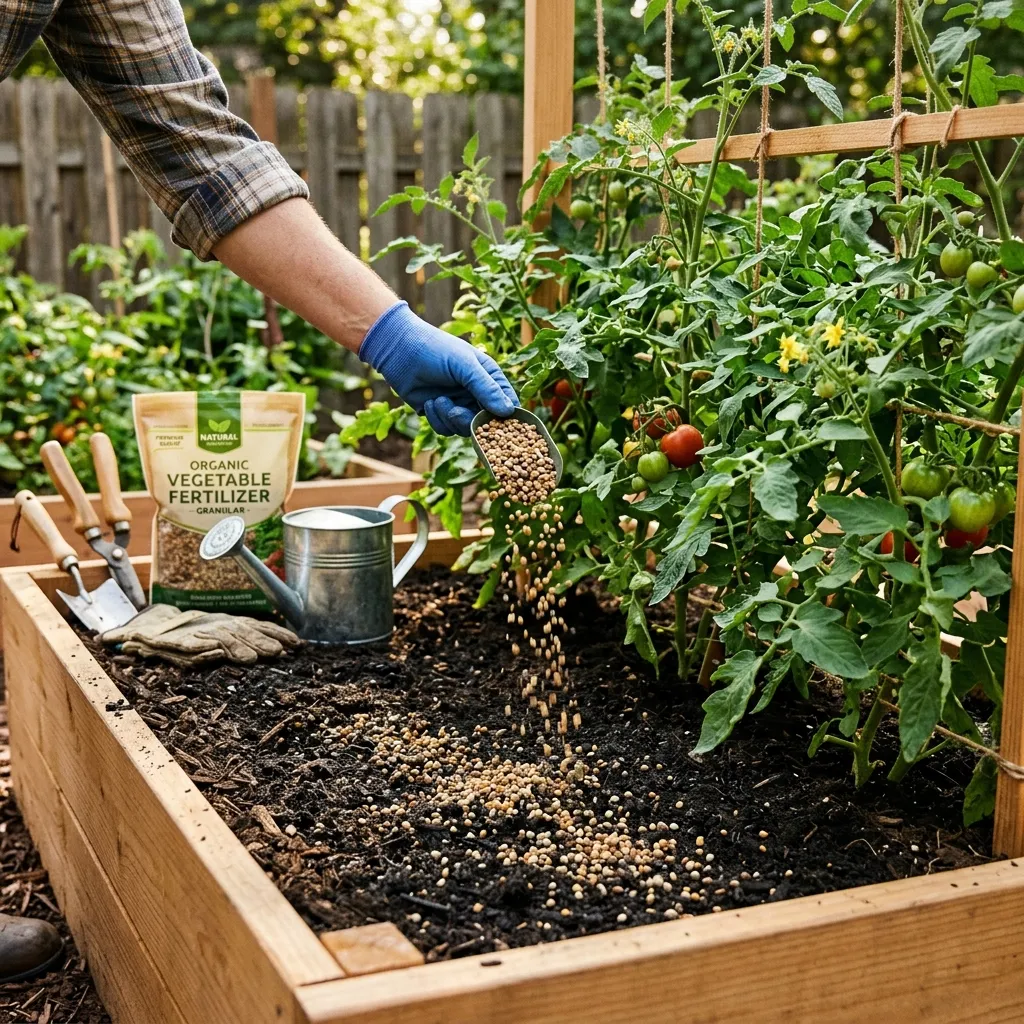
First choice when the label fits: Espoma Plant-tone
Espoma Plant-tone Organic Granular Fertilizer
- Official directions and package sizes published
- Labeled for flowers and vegetables
- Manufacturer gives a garden-bed rate
- Granular format supports measured area-based application
- Not correct for every soil-test result
- Adds multiple nutrients rather than one targeted nutrient
- No Raised Garden Hub growth or yield test
Product facts are manufacturer- or retailer-published unless this page documents a Raised Garden Hub measurement. Confirm the exact model, live price, and terms before buying.
Espoma’s current page instructs garden-bed users to mix 4 pounds per 100 square feet into the top four inches and water after application. It lists monthly use during the growing season for flowers and vegetables. Those are manufacturer directions, not an independent proof of superior yield and not permission to ignore a soil test.
Check current Plant-tone price →Calculate required product from bed area and the label. A 4×8 bed is 32 square feet, but do not convert that example into a dose unless the current label and test call for the product.
Liquid option when a measured liquid fits
Neptune's Harvest Fish-Seaweed Blend 2-3-1
- Manufacturer publishes 2-3-1 analysis
- OMRI-listed according to the official page
- Liquid format can be measured for a defined application
- Official application-rate document available
- Adds phosphorus and potassium as well as nitrogen
- Repeated purchase and mixing
- Manufacturer performance claims not independently verified here
Product facts are manufacturer- or retailer-published unless this page documents a Raised Garden Hub measurement. Confirm the exact model, live price, and terms before buying.
Buy a liquid only when its nutrient analysis, dilution directions, and application route fit the need. “Fast acting” is not automatically better, and a calendar-based two-week feeding schedule can overapply nutrients when the crop or soil does not need them.
Compare current 2-3-1 sizes →Read N-P-K as percentages, not a crop promise
The three numbers state the percentages of total nitrogen, available phosphate, and soluble potash in the bag. They do not prove that a “tomato,” “vegetable,” or “bloom” product matches your bed.
University of Minnesota Extension advises choosing an analysis closest to the soil-test recommendation. Its garden-soil data also show that many tested gardens already contain more phosphorus than needed. If phosphorus is sufficient, repeated compost, manure, or balanced fertilizer can make the mismatch worse.
Checkout checklist
- Submit a representative sample from the bed, not the path.
- Read the lab recommendation for the intended crop.
- Match the product analysis as closely as practical.
- Calculate the bed area and labeled quantity.
- Compare cost per treated square foot, not bag price.
- Confirm application method, timing, watering, storage, and protective-equipment directions.
- Record the product, date, and amount so the next test has context.
Do not fertilize symptoms blindly
Yellow leaves, weak growth, blossom problems, and low yield can also involve water, root damage, temperature, pH, soluble salts, pests, disease, or cultivar. Adding fertilizer before diagnosis can delay the real fix or increase salt and nutrient imbalance.
Use the soil-mix buyer guide for a new fill and the raised-bed total-cost calculator before checkout. Fertilizer is one project line item, not a substitute for suitable soil, drainage, irrigation, and crop fit.
Frequently asked questions
What is the best fertilizer for raised garden beds?
There is no universal best product. Choose the N-P-K analysis and application amount closest to the soil-test recommendation and crop need. Espoma Plant-tone is a documented granular candidate when its label and nutrient profile fit; Neptune's Harvest Fish-Seaweed is a documented 2-3-1 liquid candidate. Neither is automatically correct for a bed with sufficient phosphorus.
Should I test raised-bed soil before fertilizing?
Yes. University of Minnesota Extension recommends sampling the beds themselves and using the result to decide whether compost, manure, or fertilizer is needed. A test can also flag pH, organic matter, phosphorus, potassium, soluble salts, or contaminants.
How often should I fertilize a raised bed?
Use the soil-test recommendation, exact product label, crop, and observed growth rather than a universal weekly or monthly schedule. The current Plant-tone label says monthly during the growing season for flowers and vegetables and gives a separate garden-bed rate; another product may differ.
Is organic fertilizer impossible to overapply?
No. University of Minnesota Extension says even organic fertilizers can be overused and can negatively affect the environment. Compost and manure may also build phosphorus or salts. Organic describes source or certification, not unlimited application safety.
Is liquid fertilizer better than granular fertilizer?
They serve different application patterns. Granular and slow-release products require water and time to release nutrients; water-soluble or liquid products make nutrients available in solution. The right form depends on the test, label, crop stage, irrigation, and ability to measure the dose.